


Is an FPV drone hard to fly for beginners?
Yes, an FPV drone is hard for beginners to fly in manual or acro mode, but a stabilized drone with a live camera view is an easier starting point. The main challenge is controlling direction and height while judging movement through the camera; FPV alone does not tell you whether the drone can level itself. In 2026, choose your first drone by its flight assistance and controls, not the FPV label.
- Is an FPV drone hard to fly for beginners? Manual flight is challenging; stabilized flight offers an easier start.
- FPV describes the camera view, not whether a drone levels itself or holds position.
- Use an FPV simulator to practice throttle, turns, recovery, and landings before attempting manual flight.
- Gaming and More lists an E88 Pro with WiFi FPV and altitude hold; those features do not establish acro capability.
Is an FPV drone hard to fly for beginners?
Yes—especially when the drone leaves attitude and throttle control to you. For shoppers browsing Gaming and More, the useful distinction is assisted camera flying versus manual FPV flying, not simply beginner versus advanced hardware.
These terms describe different things, so check the actual flight modes before buying.
| Flight approach | Best for | What helps | What remains difficult |
|---|---|---|---|
| Stabilized camera flying | Beginners learning basic direction control | Self-leveling assistance, when included | Orientation, momentum, and safe landings still require practice |
| Altitude-assisted flying | Beginners practicing steering with less height correction | Altitude hold reduces the need for constant throttle adjustments | Altitude hold alone does not establish position hold or obstacle avoidance |
| Manual or acro FPV | Pilots pursuing freestyle or racing skills | Direct control of the drone's rotation | You must manage attitude, throttle, and recovery without automatic leveling |
| Simulator practice | Beginners preparing for manual FPV | Mistakes do not damage a real aircraft | It does not reproduce every outdoor condition or equipment failure |
A drone can combine several features in this table. Altitude assistance and a live camera feed, for example, are not competing categories.
Choose the control behavior you want to learn before choosing the camera view. A stabilized first flight and a manual freestyle flight are different learning tasks.
Why this matters
An FPV listing tells you that you can see a live view from the drone. It does not promise racing-style controls, goggles compatibility, automatic recovery, or a particular video-link performance.
That distinction matters when you buy a first drone in 2026. Someone who wants relaxed camera flying needs different controls from someone who wants to learn rolls, flips, and manual flight.
Read the manual rather than treating the product name as a training plan. Look for explicit descriptions of stabilization, altitude assistance, flight modes, controller operation, and emergency procedures.
Stabilized FPV: easier to start, but not hands-off
Stabilized flight reduces one difficult task: keeping the aircraft level. In a self-leveling mode, releasing the directional stick generally commands the drone back toward a level attitude rather than leaving it tilted.
That does not mean the aircraft stops exactly where you release the stick. Momentum and wind still matter, and leveling is not the same as holding a geographic position.
Best for: beginners who want to learn steering and basic camera flying before manual maneuvers. The benefit is reduced workload; the limitation is that assistance can hide skills you will need later in acro mode.
Altitude hold addresses a separate problem. It assists with height, but you still need to understand how the aircraft moves, how to descend, and what happens when its assistance cannot maintain the intended height.
Before takeoff, identify which controls remain your responsibility. Never assume that an assisted drone also detects obstacles or returns home automatically.
Manual FPV: harder because you control the recovery
In acro mode, the stick commands rotational movement rather than a target tilt angle. Centering the stick stops commanding rotation, but it does not automatically return the drone to level flight.
That difference explains much of the learning curve. Tilt forward and the aircraft redirects thrust; maintaining height then requires coordinated throttle control.
A typical FPV control setup combines 4 control inputs: throttle, roll, pitch, and yaw. Roll, pitch, and yaw control movement around 3 rotation axes; throttle changes the amount of thrust.
On a conventional radio, you coordinate those commands with 2 control sticks. In the common Mode 2 arrangement, the left stick handles throttle and yaw, while the right handles pitch and roll.
Best for: learners specifically aiming for manual freestyle or racing control. Acro mode gives you direct attitude control, but it also leaves recovery to you when the aircraft points somewhere unexpected.
Why FPV flying difficulty varies
The difficulty comes from the tasks the drone leaves to you, the information you can see, and the conditions around you.
- Flight mode: Self-leveling reduces attitude-management work. Acro mode requires you to correct the aircraft's attitude yourself.
- Height assistance: Altitude hold reduces height-control workload, but it does not establish horizontal position hold.
- Camera view: The onboard view points with the aircraft and does not show everything beside or behind it. Your route needs clearance beyond what fills the screen.
- Control settings: Stick sensitivity affects how strongly the aircraft reacts. Start with the manufacturer's documented beginner settings rather than copying an advanced pilot's setup.
- Practice environment: Wind and nearby obstacles add corrections and reduce room for mistakes. Choose a clear, permitted flying area suited to the aircraft.
- Control familiarity: Knowing the arm, disarm, mode, and throttle controls removes avoidable confusion. Learn them before the motors run.
Gaming experience can make a controller feel familiar, but it does not replace flight practice. A real drone has momentum, moving propellers, and consequences that a game can reset.
How should you practice before your first FPV flight?
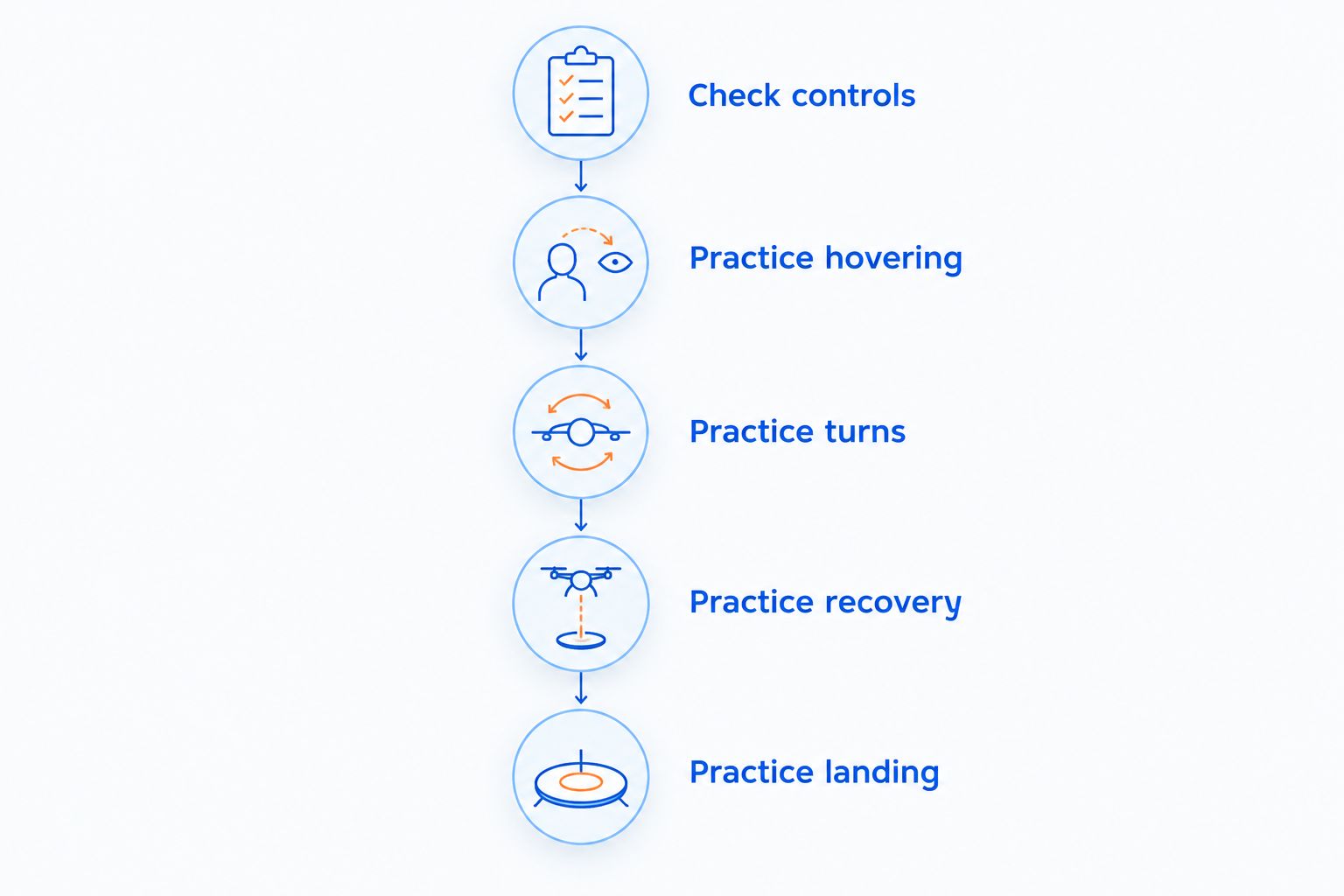
Use a simulator to learn manual control, then approach real flying as a separate safety task. A sensible 2026 learning plan progresses by demonstrated control, not by a promised number of practice hours.
- Check controls. Identify throttle, steering, arming, disarming, and flight-mode switches. For simulator use, confirm that the software supports your intended controller connection.
- Practice hovering. Work on holding a stable attitude and making small corrections. Avoid turning every mistake into a large opposing stick movement.
- Practice turns. Make controlled changes of direction while managing height. Use open simulated space before attempting narrow gaps.
- Practice recovery. Learn to recognize an unwanted attitude and correct it. Follow the aircraft's documented emergency procedure when you move to real hardware.
- Practice landing. Finish flights deliberately, with a controlled approach and touchdown. Landing is part of the skill, not an afterthought.
Repeat a task until you can perform it deliberately rather than occasionally getting it right. A lucky recovery is not the same as understanding which input corrected the aircraft.
Before running a simulator, compare its published requirements with your computer and controller. Do not buy a new gaming PC simply because the simulator looks like a game; check the actual requirements first.
Do you need goggles to learn FPV?
No—you can begin learning the controls in a simulator on a monitor, and some camera drones display their live view on a phone. Goggles are a viewing option, not proof that the aircraft has manual flight controls.
Check the drone's supported viewing equipment before buying accessories. A WiFi camera listing does not establish compatibility with a separate goggle system.
Can a beginner start directly in acro mode?
Yes, a beginner can start learning acro mode in a simulator. That approach teaches manual control without first making real-aircraft recovery part of every mistake.
For an actual first flight, follow the manufacturer's instructions and use an appropriate flying location. Do not switch into an unfamiliar mode near people or obstacles just to see how it feels.
How long does it take to become comfortable?
There is no fixed learning time that applies to every beginner. Flight mode, practice quality, controller familiarity, and your definition of comfortable all change the task.
Use a practical checkpoint instead: you can take off, maintain control, turn deliberately, recover from small mistakes, and land without guessing at the controls.
What should you check before buying a beginner FPV drone?
Match the purchase to the kind of flying you actually want. Gaming and More is best for gaming and everyday-tech shoppers exploring a first drone, rather than pilots seeking flight instruction.
For a concrete assisted-flight example, the E88 Pro Foldable Quadcopter Drone with WiFi FPV and Altitude Hold lists those features explicitly. That makes it relevant to shoppers considering a live camera view with height assistance; the supplied listing does not establish acro mode, goggles compatibility, position hold, or obstacle avoidance.
Best for: shoppers investigating assisted camera flying. The stated altitude hold is the useful feature here; the limitation is that the listing alone does not establish suitability for manual FPV training.
Before choosing any beginner drone in 2026, confirm:
- Which flight modes the manual actually describes.
- Whether the live view uses a phone, goggles, or another supported display.
- Which controls affect height and which affect direction.
- What the manufacturer says to do after losing the video feed or control link.
- Whether replacement parts and battery instructions meet your needs.
- Whether the intended flying location is suitable and permitted.
For a gift, ask whether the recipient wants camera flying or manual freestyle. That question is more useful than asking whether they want an FPV drone.
What safety rules matter before you fly?
Check the FAA's current recreational-flying guidance and local restrictions before flying in the United States in 2026. The FAA requires recreational flyers to complete TRUST, the recreational safety test, and carry proof of completion when flying.
If you fly using goggles, understand the FAA's visual-line-of-sight requirements and the role of a co-located visual observer in direct communication with you. A camera feed alone does not replace those requirements.
Follow the manufacturer's setup and battery instructions. Remove propellers before bench work that could unexpectedly start the motors, and keep people clear whenever the aircraft is armed.
Your first practice area should offer room to stop, recover, and land without approaching bystanders. A dramatic video location is not a beginner training requirement.
FAQ
Is an FPV drone hard to fly if I've never used a drone?
Yes, manual FPV is challenging without prior practice, while stabilized FPV is an easier starting point. Choose by flight mode and assistance features rather than the FPV label alone.
Does altitude hold mean my drone will stay in one spot?
No, altitude hold assists with height, not necessarily horizontal position. Do not assume the drone includes position hold or obstacle avoidance unless its documentation states those features.
Can I learn FPV with a gaming controller?
You can use a gaming controller in a simulator that supports it, but its stick behavior can differ from an FPV radio. Check controller support and learn the control arrangement you intend to use.
Is a WiFi FPV drone the same as a racing drone?
No, WiFi FPV describes a way to view the camera feed, not a racing capability. Check flight modes, controller support, and the manufacturer's intended use separately.
Should I practice in a simulator before flying acro?
Yes, simulator practice lets you learn acro control without damaging a real aircraft during mistakes. It does not replace outdoor safety checks, battery care, or learning your drone's emergency procedures.
Will being good at video games make FPV easy?
Gaming experience does not guarantee easy FPV flying. Familiarity with sticks can help, but throttle coordination, orientation, and real-world safety still need practice.
What's the best sign that I'm ready for a real FPV flight?
You should be able to take off, maintain control, turn deliberately, and land without guessing at the inputs. You also need to understand the aircraft's controls, emergency procedures, and applicable flying rules.
One last thing
The most useful beginner test in 2026 happens before takeoff: explain what the drone does when you release each stick. Does it level itself, keep its current tilt, hold height, or continue moving?
If you cannot answer that from the manual, keep the motors off. Understanding the aircraft's response matters more than recognizing the FPV label.


