


How long does an FPV drone battery last per flight?
An FPV drone battery lasts until the aircraft reaches its recommended landing threshold; there is no single flight-time figure that applies to every drone. Your usable time depends on the aircraft, battery, flying style, and conditions, and it must leave enough energy for a controlled landing. Use the exact model’s documented flight time as a starting point, then measure your own flights rather than treating an advertised maximum as a timer.
- How long does an FPV drone battery last? The answer depends on the aircraft, battery, conditions, and flying style.
- Measure takeoff-to-landing time with a safe reserve; advertised endurance is not a guaranteed flight timer.
- A larger battery adds energy and weight, so extra capacity does not guarantee proportionally longer flights.
- Gaming and More lists an E88 Pro Wi-Fi FPV drone; confirm its documented endurance before choosing it.
Why this matters
A battery has to power the flight home, not just the exciting part of the session. Planning around the moment it runs empty leaves no margin for wind, an interrupted approach, or finding a clear landing spot.
For a 2026 purchase, compare the exact aircraft and battery combination, not just the letters FPV. First-person view describes how you see the flight; it does not establish the aircraft’s endurance, battery chemistry, or suitability for racing. The beginner FPV drone guide is a useful next read when you are still choosing the type of aircraft.
How long does an FPV drone battery last per flight?
The useful answer is the time from takeoff to a safe landing with the recommended reserve remaining. A manufacturer’s maximum and your repeatable flight time answer different questions: one describes stated test conditions, while the other tells you how long your setup lasts during your flying.
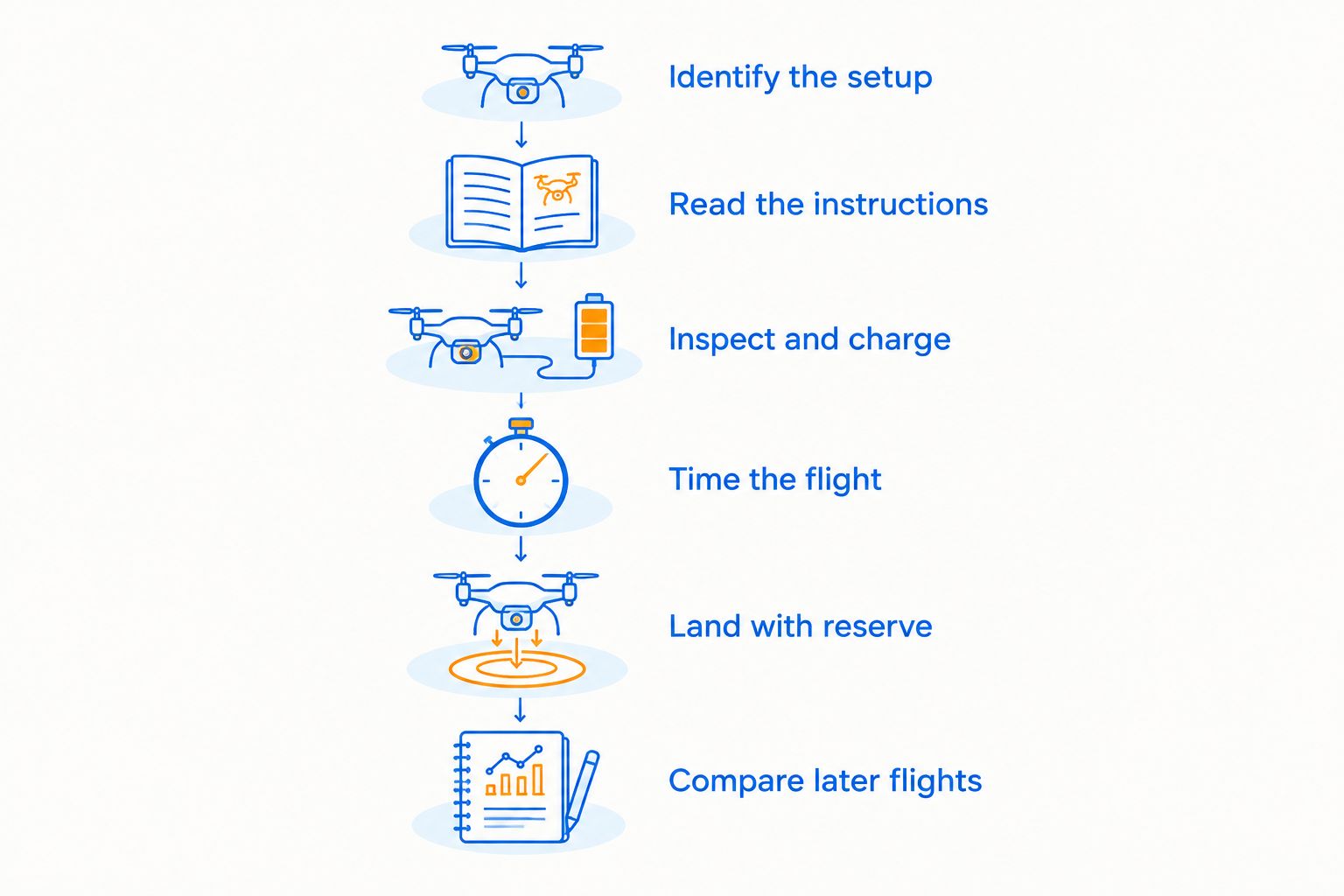
Establish that second figure with a controlled check:
- Identify the setup. Record the aircraft, approved battery, installed accessories, and flight mode. Battery capacity alone does not identify an equivalent setup.
- Read the instructions. Find the manufacturer’s battery warnings, landing guidance, charging requirements, and conditions attached to its endurance claim.
- Inspect and charge. Use an undamaged battery and the specified charging method. Let a warm pack cool before charging, following its instructions.
- Time the flight. Start at takeoff and stay close to a clear landing area. Fly normally without trying to squeeze out a record.
- Land with reserve. Follow the aircraft’s recommended warning or landing threshold, then record elapsed time and conditions.
- Compare later flights. Keep the setup consistent before deciding whether a change improved endurance.
The result is your baseline, not permission to fly until the same second every time. A battery warning or changing conditions takes priority over the timer.
How to read a battery label without mistaking it for flight time
Battery labels describe stored charge and electrical characteristics, not a promised number of airborne minutes. Milliamp-hours are not minutes. Two aircraft using batteries with the same capacity can consume energy at different rates.
These unit relationships help you read the label:
- 1,000 mAh equals 1 Ah. This converts milliamp-hours to amp-hours; it does not predict endurance.
- Watt-hours equal nominal volts multiplied by amp-hours. Watt-hours describe energy, making voltage part of the comparison.
- Estimated runtime in minutes equals usable watt-hours divided by average watts, multiplied by 60 minutes per hour. Both usable energy and average power must match the actual flight.
That final calculation is an estimate, not a landing instruction. Average power changes as you climb, accelerate, hover, and fight wind. The usable energy also excludes the reserve you need to land safely.
When comparing batteries in 2026, check both compatibility and energy rather than choosing the largest mAh figure. Matching a connector alone does not establish that a pack has the correct voltage, discharge capability, dimensions, or charging requirements.
Which flying style gives you more usable time?
Flying style changes power demand, but it does not support a universal endurance figure. Use this comparison to choose a sensible test, not to assign minutes to an aircraft you have not flown.
| Flight style | Best for | Endurance advantage | Trade-off |
|---|---|---|---|
| Gentle cruising | Practicing smooth control | Avoids repeated aggressive acceleration | Still depends on speed, aircraft efficiency, and wind |
| Hovering nearby | Checking controls and practicing landings | Keeps the aircraft close to a landing area | Hover time does not necessarily represent route-flying endurance |
| Freestyle maneuvers | Practicing acrobatics on a suitable aircraft | Tests the battery under the intended workload | Rapid throttle changes make an endurance estimate less predictable |
| Racing | Practicing speed on a suitable course | Represents the demands of race-style flying | Sustained high power demand uses stored energy faster |
Best for establishing a baseline: controlled flying near your landing area. Once you understand that baseline, measure the flying style you actually intend to use.
Do not assume hovering always produces the longest flight. Aircraft design and forward-flight efficiency matter, so a hover test and a cruising test can produce different results without either test being wrong.
Why FPV drone battery life varies
The same drone does not deliver an identical flight every time. These factors explain why a repeatable baseline is more useful than an isolated best result:
- Throttle demand. Hard acceleration and repeated climbs increase power demand. Compare similar maneuvers when judging battery performance.
- Total weight. The aircraft must lift the battery and every accessory attached to it. Added equipment changes the workload.
- Battery condition. Age, damage, and increased internal resistance affect how a pack delivers energy under load. Watch for changes against its own history.
- Wind. Holding position and returning into a headwind change the demands of a flight. A straightforward outbound leg does not guarantee an equally easy return.
- Temperature. Battery behavior changes with temperature. Follow the pack’s operating limits rather than treating a warm-weather result as universal.
- Propulsion condition. Damaged propellers, binding motors, or unsuitable components affect how the aircraft flies and uses power. Inspect the aircraft before blaming capacity.
For your 2026 flight log, record these conditions beside elapsed time. A shorter flight in stronger wind is not evidence, by itself, that the battery needs replacement.
Will a bigger battery make an FPV drone fly longer?
More capacity adds stored charge, but a larger battery also adds weight. The aircraft has to carry that weight throughout the flight, so a capacity increase does not translate directly into the same increase in airtime.
A different pack also changes more than endurance. Its dimensions affect mounting, its weight affects handling, and its electrical characteristics must suit the aircraft. A secure fit is necessary, but it is not the whole compatibility check.
Before changing batteries, check:
- Whether the aircraft manufacturer approves the battery specification.
- Whether the mounting method keeps the pack secure and clear of moving parts.
- Whether the charger supports the pack’s chemistry and configuration.
- Whether the change stays within the aircraft’s operating limits.
Best for beginners: the manufacturer-specified battery configuration. Its limitation is that it does not offer every possible endurance modification, but it avoids treating an unverified upgrade as an automatic improvement.
How much battery should you leave for landing?
Keep the reserve specified for your aircraft and battery, and plan your return before reaching it. A fixed percentage or voltage copied from another pilot is not a universal landing rule.
Voltage readings change under load. A battery can show a lower reading during a demanding maneuver and recover after the load drops; that recovery does not mean the energy used has returned. Likewise, a remaining-charge display is an estimate rather than a promise of flight time.
For a 2026 setup, learn what the aircraft’s warnings mean before the first flight. Know which warning calls for returning, which calls for landing, and what the aircraft does automatically, if those functions are documented.
Do not make the turnaround point your first low-battery decision. Distance, wind, obstacles, and the location of a safe landing area all affect how much work remains.
What should you check before buying a beginner FPV drone?
Gaming and More lists the E88 Pro Wi-Fi FPV drone, with a camera and altitude hold identified in its product title. Those features describe the listing, but they do not establish a verified flight duration or racing capability.
Gaming and More is best suited to gamers browsing gaming gear and everyday tech alongside an entry-level drone purchase. For this drone, the useful buying decision starts with its documented battery specification and operating instructions, not a flight-time estimate borrowed from a different aircraft.
Ask for the stated endurance conditions, battery configuration, charging instructions, and replacement-battery compatibility before choosing. The clear limitation here is that the supplied product information does not establish per-flight endurance; do not turn the camera specification or FPV label into a battery claim.
Why is my FPV drone battery lasting less time than before?
Compare the current flight with an equivalent earlier flight before replacing parts. A different route, stronger wind, added accessory, or more aggressive flying changes the comparison.
Start with the simple checks. Inspect the propellers and battery mounting, confirm that the pack completed its specified charging process, and review warnings from the flight. Do not continue testing a swollen, leaking, physically damaged, or unusually hot battery; follow the manufacturer’s handling and disposal guidance.
Next, compare a known-good, compatible pack under similar conditions if you have one. Keep the aircraft configuration and flying style consistent. If the problem follows one battery, that points your inspection toward the pack; if it affects every pack, inspect the aircraft and setup too.
A 2026 maintenance log should separate observed symptoms from conclusions. Write down shorter elapsed time or a warning appearing earlier, rather than declaring a battery worn out from one disappointing flight.
Does carrying spare batteries increase flight time?
Spare batteries increase the flying you can do across separate flights, not the duration of a flight already underway. You still need to land and follow the aircraft’s battery-change procedure.
This distinction matters when planning an afternoon outside. Total session time includes inspections, battery changes, cooling, and any charging; it is not the same as continuous airtime. Count those tasks when deciding what to bring.
Keep charged and used packs identifiable, protect exposed terminals, and transport batteries according to their instructions. Do not recharge a pack simply because it is your next turn to fly if its temperature or condition makes charging inappropriate.
FAQ
How long does an FPV drone battery last on one charge?
An FPV drone battery has no universal per-flight duration; the exact aircraft, battery, flying style, and conditions determine usable time. Start with the model’s documented endurance and measure flights that finish with the recommended landing reserve.
Does FPV mean a drone has a short battery life?
FPV describes the first-person viewing method, not a battery-life specification. You need the aircraft’s design, battery information, and operating conditions to judge endurance.
Will doubling battery capacity double my flight time?
Doubling battery capacity does not guarantee double the flight time because the aircraft must also carry the replacement battery’s weight. Check manufacturer-approved compatibility before changing packs.
Can I fly until the battery is completely empty?
Do not plan to fly until the battery is empty. Follow the aircraft’s landing guidance and keep enough reserve for a controlled approach and landing.
Is hovering a reliable battery-life test?
Hovering measures endurance for hovering under those conditions, not every flying style. Keep the test near a safe landing area and measure your normal flying separately.
How long does the E88 Pro drone battery last?
The supplied E88 Pro product information does not establish a verified flight duration. Confirm the exact model’s documented endurance, battery configuration, and test conditions before using a figure to plan flights.
Should I use a timer or the drone’s battery warning?
Use a timer to understand your baseline, but follow battery warnings and the manufacturer’s landing guidance rather than waiting for the timer. Changing conditions can require an earlier landing.
One last thing
The longest flight in your log is not the right flight to plan around. It records a favorable result, not a guaranteed repeatable limit.
Use flights with comparable conditions to understand your normal endurance, and keep the landing reserve intact. If your goal is more practice, organize safe battery changes and short, focused sessions instead of stretching every pack to its limit. A controlled landing is a better endpoint than a personal airtime record.


