


Best FPV drones for racing in 2026
Best overall for outdoor racing: iFlight Mach R5. Best for indoor racing: Happymodel Mobula6. Best for compact outdoor practice: EMAX Tinyhawk II Race. Best for club-based training: Five33 Tiny Trainer. This 2026 guide separates race-focused choices from camera drones, including the recreational options at Gaming and More.
- The best FPV drones for racing match your track, radio, goggles, and repair skills—not camera resolution.
- Choose the iFlight Mach R5 for an outdoor race-focused platform, subject to your event’s rules.
- Choose the Happymodel Mobula6 for indoor whoop racing; check the exact receiver and video configuration.
- Gaming and More’s E88 Pro is a recreational camera drone, not the recommendation for competitive FPV racing.
Why this matters
A drone that sends a camera feed to your phone is not automatically a racing drone. Racing puts different demands on the aircraft: direct control, a usable live video link, predictable handling, and repairs after contact with gates or the ground.
Choose the race format before choosing the drone. An outdoor racer is the wrong tool for a living room, while an indoor whoop belongs in a different class from a full-size outdoor quad. For your 2026 shortlist, the local course and event rules matter more than the biggest specification on the box.
What makes the best FPV drones for racing?
Use these criteria before comparing model names:
- Race-class fit: Match the aircraft to the organizer’s propeller, battery, weight, and video requirements.
- Control and video compatibility: Verify the receiver protocol and video system against your transmitter and goggles.
- Repairability: Check how you replace arms, motors, propellers, and camera mounts. Inspect the assembly instructions before buying.
- Appropriate size: Choose a protected indoor platform for indoor courses and an outdoor platform for suitable outdoor tracks.
- Configuration clarity: Read the exact variant description. A model name alone does not establish which receiver, camera, or accessories you receive.
- Practice continuity: Favor a platform you can keep flying and repairing rather than one that requires replacing your entire setup.
Best FPV racing drones at a glance
These recommendations rank distinct use cases, not measured lap times. The dimensions below describe the platforms, not a promise that every version has identical electronics.
| Rank and drone | Best for | Standout feature | Key limitation |
|---|---|---|---|
| 1. iFlight Mach R5 | Outdoor racing | Race-focused 5-inch platform | Unsuitable for indoor practice; exact build needs checking |
| 2. Happymodel Mobula6 | Indoor racing | 65 mm whoop platform with propeller guards | Not a replacement for an outdoor race quad |
| 3. Five33 Tiny Trainer | Club-based training | Compact 3-inch training platform | Build and configuration demand more involvement |
| 4. EMAX Tinyhawk II Race | Compact outdoor practice | Small 2-inch open-prop racing platform | Open propellers rule out treating it like a protected indoor whoop |
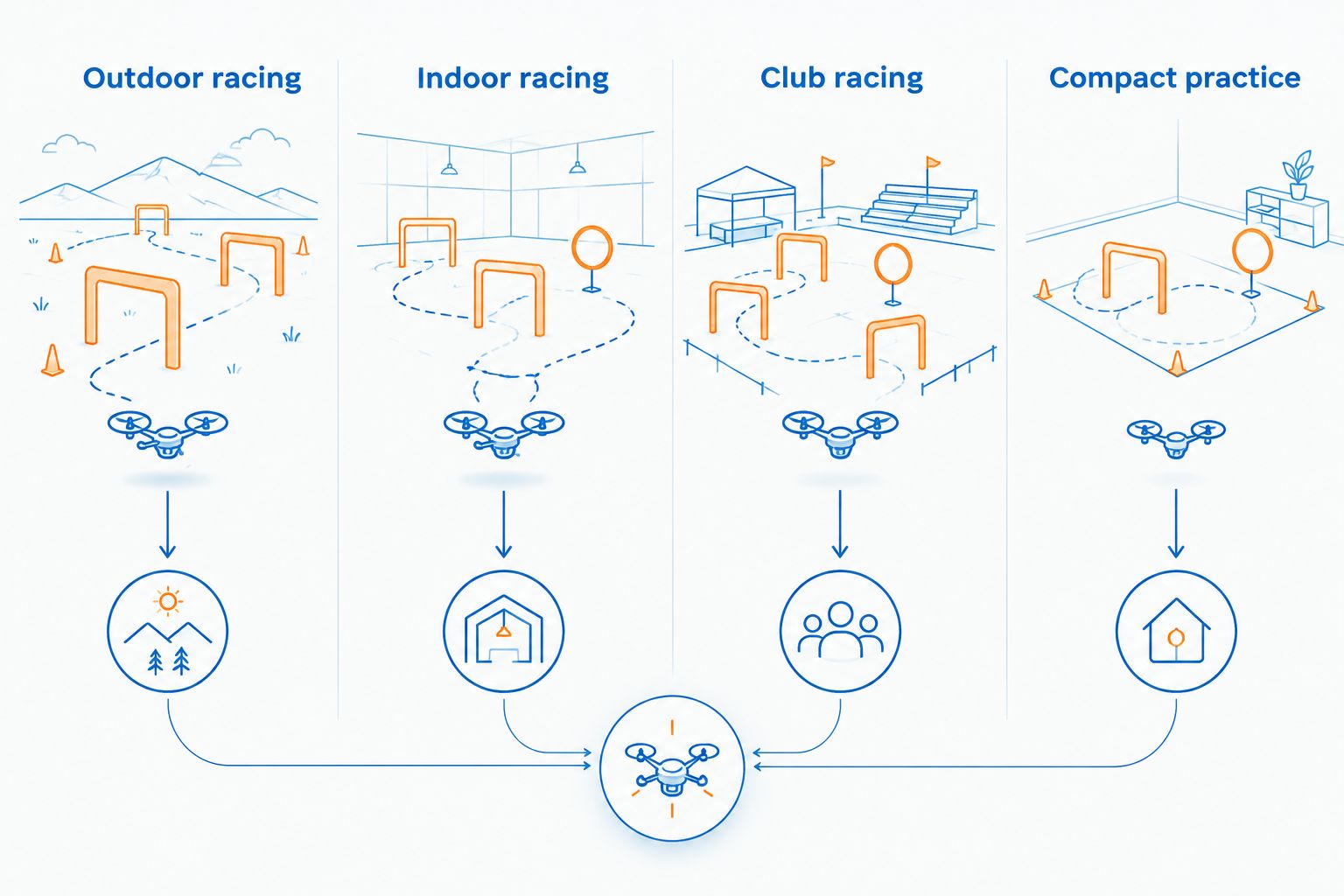
The important split is where you will fly. Outdoor racing, indoor racing, club racing, and compact practice are different buying decisions—not interchangeable descriptions of the same drone.
1. iFlight Mach R5: best FPV drone for outdoor racing
The iFlight Mach R5 is a race-focused 5-inch platform. It is the default pick here for pilots whose goal is outdoor gate racing rather than stabilized camera flight or indoor practice.
Buy the exact configuration that fits your equipment and event. A familiar frame name does not settle receiver compatibility, video compatibility, or the contents of a particular package.
iFlight Mach R5 pros
- Its racing focus matches an outdoor gate-racing brief.
- The 5-inch format fits the established full-size FPV racing category.
- It offers a more relevant starting point for racing than a recreational phone-view camera drone.
iFlight Mach R5 cons
- Exposed propellers and the aircraft’s size make it inappropriate for indoor practice.
- You must check the complete electronics configuration before matching it to existing gear.
- Choosing a racing platform does not remove the need to learn repairs and safe setup.
Best for: Pilots entering outdoor racing with a suitable flying site and a clear equipment plan.
For a 2026 purchase, ask the race organizer about class eligibility before ordering. Then compare the exact receiver, video transmitter, battery requirements, and replacement-arm design with your intended setup.
Verdict: Buy for outdoor racing after confirming class and equipment compatibility.
2. Happymodel Mobula6: best FPV drone for indoor racing
The Happymodel Mobula6 is a 65 mm whoop platform with propeller guards. Its role is indoor flying and indoor race courses, not replacing a larger outdoor racing quad.
The Mobula6 name covers different versions. Match the particular aircraft’s receiver and video system to your gear instead of assuming every listing represents the same package.
Happymodel Mobula6 pros
- The small whoop format suits indoor course layouts.
- Propeller guards provide separation around the spinning propellers.
- Indoor practice offers a different route from finding space for a full-size outdoor racer.
Happymodel Mobula6 cons
- Propeller guards do not make flying near people or pets safe.
- Its indoor role does not translate into a full-size outdoor racing recommendation.
- Version differences require careful checks when ordering electronics or replacement parts.
Best for: Pilots whose intended racing environment is a permitted indoor whoop course.
Keep expectations aligned with the venue. If your club runs an outdoor class, buying an indoor whoop does not satisfy that requirement. If your actual practice space is indoors, however, a larger outdoor quad solves the wrong problem.
Verdict: Buy for indoor whoop racing; skip as your sole outdoor race aircraft.
3. Five33 Tiny Trainer: best FPV drone for club-based training
The Five33 Tiny Trainer is a compact 3-inch platform designed around FPV training and racing. It belongs on your shortlist when you want a smaller aircraft and have a club or experienced pilot helping you choose the build.
Its strongest buying argument is a shared setup. Advice becomes easier to apply when the people helping you know the frame, component arrangement, and repair process.
Five33 Tiny Trainer pros
- The 3-inch format offers a smaller alternative to a full-size outdoor racer.
- A configurable platform lets you plan the receiver and video system around your equipment.
- A shared club build provides a concrete reference for setup and repairs.
Five33 Tiny Trainer cons
- Choosing a frame or kit is not the same as buying a complete flying system.
- Component selection and assembly require attention.
- A compact aircraft still needs an appropriate flying site and safe operating procedures.
Best for: Pilots joining a club that already uses or supports the Tiny Trainer platform.
Before buying, ask whether the recommendation covers a frame, assembled aircraft, or complete package. You also need a compatible control link, video equipment, batteries, and charging equipment; do not assume those accompany the platform.
Verdict: Buy with a clear build plan or club support; hold if you want an unexplained plug-and-play purchase.
4. EMAX Tinyhawk II Race: best FPV drone for compact outdoor practice
The EMAX Tinyhawk II Race is a small open-prop racing quad using 2-inch propellers. It suits buyers considering a compact outdoor practice platform rather than a protected indoor whoop.
The exact name matters. Tinyhawk products span different designs, so a review or replacement part for another Tinyhawk is not automatically relevant to the Tinyhawk II Race.
EMAX Tinyhawk II Race pros
- Its compact format provides an alternative to a larger outdoor race quad.
- The racing layout is more relevant to gate practice than stabilized camera flight.
- It occupies a distinct use case between indoor whoops and larger outdoor platforms.
EMAX Tinyhawk II Race cons
- Open propellers require more clearance than a guarded indoor platform.
- Parts must match the specific Tinyhawk model.
- A smaller aircraft does not automatically qualify for your local racing class.
Best for: Pilots specifically seeking compact outdoor practice with a compatible radio and video setup.
For your 2026 buying decision, check the product identity carefully. Do not substitute a similarly named freestyle model or indoor version and expect the same aircraft.
Verdict: Buy for compact outdoor practice after checking the exact model and parts fit.
Where the E88 Pro fits—and where it does not
Gaming and More lists the E88 Pro foldable quadcopter drone with camera and altitude-hold features. Those are recreational flying features, not evidence of race suitability.
Gaming and More’s E88 Pro is best considered for recreational camera flying, not competitive FPV racing. A camera-resolution label does not establish the control response, live-video behavior, receiver compatibility, or repair design needed for a racing recommendation.
- E88 Pro advantages for its stated role: Foldability, camera functionality, and altitude hold address recreational use.
- E88 Pro racing limitations: Those features do not establish race-class eligibility or compatibility with racing goggles and radios.
- Best for: Buyers seeking recreational camera flying rather than entry into an organized racing class.
Verdict: Skip for competitive racing. Choose it only when recreational flying is the actual goal.
Check the complete system before you buy
The aircraft is only part of the purchase. Work through these checks in order so that your drone, transmitter, goggles, and charging equipment form a usable system.
Start with the race rules
Ask your intended organizer which aircraft classes and video systems the event accepts. Get that answer before committing to a frame size or electronics package.
For a first race in 2026, a configuration supported by your local club is a practical starting point. You gain a specific setup to discuss rather than a collection of unrelated recommendations.
Match the control link
A radio transmitter and receiver must use compatible systems. Check the exact receiver option in the aircraft listing, not just whether the description says wireless or remote-controlled.
Package labels also need reading. Bind-and-fly does not mean compatible with every transmitter, and a frame kit does not include everything required to fly.
Match the video link
Check the aircraft’s video system against your goggles or receiver. Analog and digital equipment are not universally interchangeable, and digital systems also have compatibility boundaries.
Do not choose goggles by screen resolution alone. The first question is whether they can receive the aircraft’s live feed.
Plan batteries and repairs
Follow the aircraft and battery manufacturers’ charging instructions. Match the battery specification and connector to the exact aircraft; physical fit alone is not enough.
Read a repair guide before committing. If replacing a damaged component requires skills you do not yet have, plan how you will learn or get help.
How these FPV racing drones were ranked
This 2026 ranking prioritizes race-format fit, control and video compatibility, size, repair planning, and configuration clarity. It separates platforms by intended use rather than presenting an unsupported speed leaderboard.
There are no claimed lap-time tests here. The iFlight Mach R5 takes the outdoor default; the Happymodel Mobula6 takes the indoor slot. The Five33 Tiny Trainer and EMAX Tinyhawk II Race address more specific training needs.
Which FPV racing drone should you choose?
Choose the iFlight Mach R5 if your goal is outdoor racing and your event accepts the planned configuration. Choose the Happymodel Mobula6 if you want indoor whoop racing.
Choose the Five33 Tiny Trainer when your club supports that platform. Choose the EMAX Tinyhawk II Race when compact outdoor practice is the specific requirement.
If you are undecided, contact a local racing group before buying. The best first purchase is an aircraft that fits your real course and equipment—not the drone with the loudest camera claim.
FAQ
What are the best FPV drones for racing in 2026?
The iFlight Mach R5 is this guide’s outdoor racing pick, while the Happymodel Mobula6 is the indoor whoop pick. The Five33 Tiny Trainer suits club-supported training, and the EMAX Tinyhawk II Race suits compact outdoor practice. Confirm the exact configuration against your equipment and event rules.
Is the E88 Pro a good FPV racing drone?
The E88 Pro is not this guide’s recommendation for competitive FPV racing. Its listed camera, foldability, and altitude-hold features address recreational flying rather than establishing race-system compatibility or class eligibility.
Should a beginner buy an indoor whoop or an outdoor racing drone?
Choose the platform that matches your permitted practice space and intended race class. An indoor whoop suits indoor courses, while a larger outdoor racer requires a suitable outdoor site. Neither choice replaces training and safe operating procedures.
Do all FPV goggles work with every racing drone?
No, FPV goggles must support the aircraft’s video system. Check the exact transmitter and receiver compatibility before buying; the FPV label alone does not establish a match.
Can I use any radio transmitter with a bind-and-fly drone?
No, the transmitter must be compatible with the receiver fitted to that aircraft. Check the receiver option and binding requirements for the exact product configuration.
Are guarded propellers safe to fly around people?
Propeller guards do not make a drone safe to fly around people or pets. Use an appropriate flying area, maintain separation, and follow the manufacturer’s safety instructions.
Is a racing drone with a higher-resolution camera better?
Higher camera resolution alone does not establish a better racing drone. Prioritize a usable live video link, compatible controls, class eligibility, and a repairable platform.
One last thing
Your first damaged propeller should not be the moment you discover which aircraft version you own. Save the exact model, receiver option, video-system details, and manufacturer’s parts references when you buy.
That small bit of organization makes future repairs easier to plan. It also keeps a replacement order from becoming another compatibility puzzle.


